Agent security
AI Security Vendors in 2026: A Guide to the Enterprise AI Security Landscape
Understand AI security layers, evaluate the evidence and see where Harden adds a supported pre-execution boundary for coding-agent work.
Executive summary
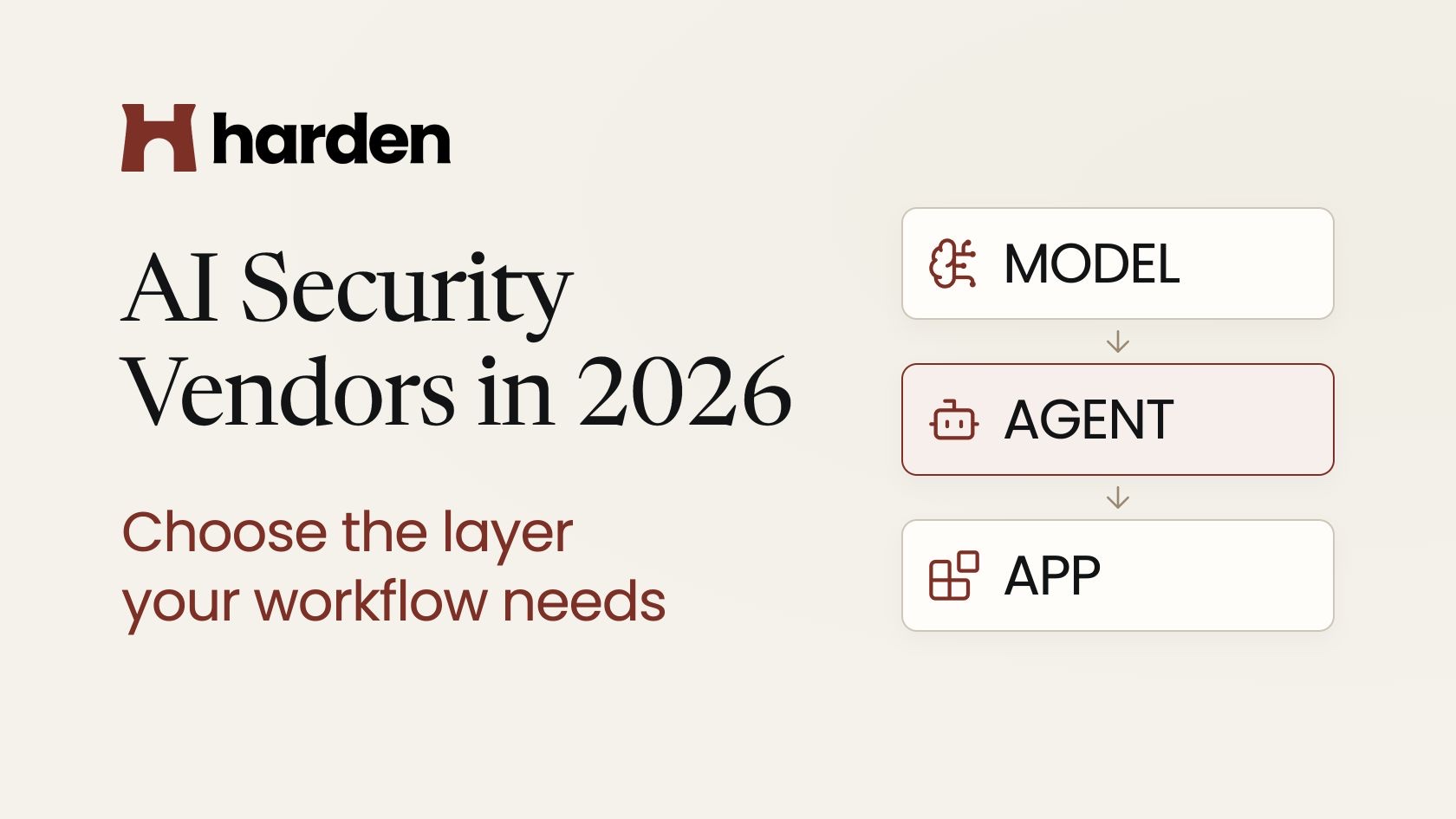
Evaluate AI security vendors by the system you need to protect and the action you need to control. Model testing, application safeguards, identity management and coding-agent security solve different problems. For teams using agents to build software, the important question is whether a proposed operation stays within the developer's task before it changes a file, reaches a service or moves information. Our approach at Harden starts with that supported action boundary, alongside the controls the organization already operates.
Define which AI system you are buying for
A developer asks an agent to investigate a staging failure. The agent can inspect code, run shell commands and retrieve diagnostics. It may also inherit a credential that reaches production. The buying question is concrete: which control can distinguish the assigned staging task from a proposed production change?
Now consider a customer-facing assistant answering questions from a document collection. That application needs attention to retrieved content, user permissions and responses. Its deployment differs from the developer's workstation, even if both systems use the same model.
Write the workload before comparing product features. Identify the owner, tools, credentials, sensitive information and consequential operations. Our enterprise security-policy guide turns those responsibilities into controls that a team can assign and review.
Endpoint and coding-agent action controls
Coding agents turn instructions into operations: editing files, invoking commands, calling APIs and using connected tools. A code scanner can assess the resulting diff. That does not, by itself, explain whether an earlier upload or infrastructure command belonged to the developer's assignment.
At Harden, we evaluate supported calls before execution using the proposed action, relevant task context and configured policy. A covered call can be allowed, redacted or blocked. This is the role to evaluate when the unresolved problem is an agent using available authority for the wrong purpose.
Check the exact integration, operating system, agent version and tool path. A demonstration through one shell integration does not establish coverage for a separate remote connector. Keep native permissions, host protection and resource authorization in the design.
Identity, access and tool governance
Identity controls establish which account an operation uses and what that account can reach. Tool governance establishes which connections are permitted, who owns them and how access is revoked. Both matter before an agent starts work.
For the staging investigation, give the workflow a staging-scoped identity where possible. Record its lifetime and permitted operations. An administrator's broad account is a poor substitute for an explicit task scope.
Identity and task authorization remain distinct. A valid credential may permit an upload while the current assignment does not permit that recipient or dataset. NIST's least-privilege principle provides a foundation for limiting that authority. Record the identity, resource, permitted effect and expiry together.
Context and sensitive-data protection
Sensitive information can appear in a prompt, command argument, tool response, file or diagnostic attachment. Ask where inspection happens and whether the control can affect the operation before the information reaches its recipient.
Different flows need different decisions. Removing an unnecessary secret from a diagnostic note can preserve useful work. Removing the credential required to authenticate a request can break the request. In our published research, we explain a supported diagnostic-redaction example and the circumstances in which a call is blocked instead.
Include destinations in the review. A document need not contain a recognizable secret to be inappropriate for an external recipient. Keep data classification, recipient authority and the purpose of the transfer together.
Application, model and broader lifecycle security
Application security covers the software and integrations around model use. Model evaluation examines behavior under defined conditions. Supply-chain review concerns the components, dependencies and delivery process. Each can uncover problems that an action-time check does not replace.
NIST's AI Risk Management Framework provides a broader basis for organizing AI risk across design, development, use and evaluation. It is a voluntary framework, not a product certification or a ranking of security tools.
For a generative AI platform, separate the development workflow from the deployed service. Harden's coding-agent action boundary is relevant while developers delegate consequential operations to supported agents. The application's own authentication, authorization, testing and operational controls still need accountable owners.
Research, testing and operational evidence
Read research for the mechanism it demonstrates and the conditions under which it was evaluated. AgentDojo evaluates tool-using agents on legitimate tasks and adversarial cases. Its methodology distinguishes completing useful work from satisfying an attacker's objective. That distinction matters when evaluating a security control: stopping everything is not successful delegation.
InjecAgent studies malicious instructions arriving through external tool content, including attempts to misuse other tools. Its experiments support examining the transition from retrieved information to a consequential action. They are not measurements of your current developer fleet or proof of a product's effectiveness.
Our practical recommendation is to retain three separate observations: the developer's permitted task, the decision on the proposed action and the effect recorded by the destination. An agent's explanation alone does not establish what happened.
Build a shortlist around questions
Start with one workflow and a small control map:
Responsibility | Evidence to request |
|---|---|
Establish authority | The actual identity, resource scope and revocation process |
Bound execution | The supported operation and where enforcement occurs |
Protect information | The inspected field, permitted recipient and resulting decision |
Preserve useful work | A legitimate task that still completes |
Investigate the outcome | A decision record joined to the actual resource effect |
Operate the control | Documented behavior during failures, upgrades and policy changes |
For the staging example, first run an approved diagnostic operation. Then change only the target to production in a disposable test. Inspect whether the expected control handled that variation and whether the original task still works. Record the configuration and uncovered routes.
An evaluation should end with a clear responsibility, owner and remaining gap. For the coding-agent layer, start a Harden evaluation in Control with that workflow. Configure the supported integration before judging its result. The account is the starting point; the useful evidence comes from the operation your team actually needs to govern.
FAQs
What does an AI security vendor protect?
It depends on the control and deployment. A product may address model behavior, application requests, agent actions, identity or sensitive information. Start with the specific system and consequence. A broad category label does not establish which operations a product can observe or constrain.
Where does Harden fit in the AI security landscape?
Harden focuses on supported coding-agent calls before execution. We evaluate the proposed action with relevant task context and configured policy, then allow, redact or block it. That role complements controls protecting identities, hosts and the resulting application code.
What should a team building a generative AI platform evaluate first?
Separate the platform's development workflow from its deployed application. Map the agents, tools, identities and data involved in each. Evaluate the consequential operations that currently lack a clear control owner, rather than buying against a generic feature list.
Are discovery and enforcement the same capability?
No. Discovery establishes what is visible within its scope. Enforcement concerns what happens to a covered operation. Ask for evidence of each responsibility and connect the decision to the actual effect. Seeing an agent in a dashboard does not establish control over its calls.
How can we begin evaluating Harden?
Choose one representative coding-agent workflow and define an allowed operation plus a prohibited variation. Start in Control, verify the current supported setup, and configure the integration. Review legitimate task completion, the security decision and the resulting resource evidence together.