Agent security
What Should Be in an AI Agent Security Policy? 10 Controls Every Enterprise Needs
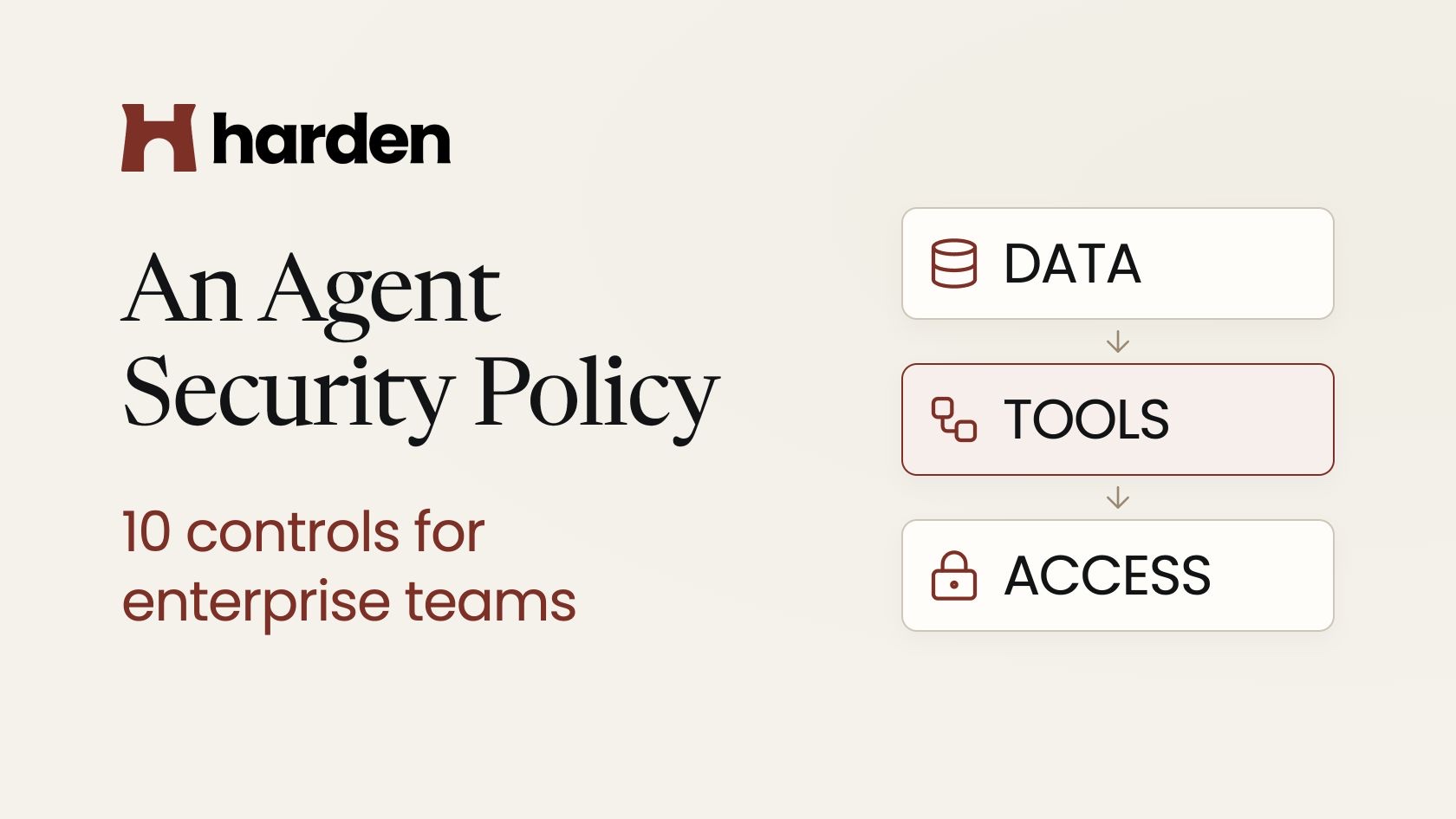
An AI agent security policy should define who owns an agent, which tasks it may perform, which systems it may reach and how the organization checks and records consequential actions.
Executive summary
An AI agent security policy should define who owns an agent, which tasks it may perform, which systems it may reach and how the organization checks and records consequential actions. A useful policy connects each rule to an implementation owner and evidence. A statement such as “use AI responsibly” does not tell a developer whether an agent may install a package, upload logs or deploy to production.
Write rules around actions people can recognize
Consider a coding agent asked to investigate a failing build. Reading source and running a local test may be reasonable. Sending repository contents to an unapproved service is a different operation, even if the agent describes it as troubleshooting.
The policy should make that distinction before a developer has to improvise. Use ordinary verbs: read, change, install, send, deploy and delete. Then name the systems and conditions attached to them.
The ten controls below are a proposed enterprise checklist. They are not a claim that a single product implements every control or that the list is a formal standard.
1. Assign an owner to every approved agent workflow
Record the business owner, technical owner and security contact. Include the team using the agent and the process it supports. A tool that nobody owns will accumulate exceptions nobody revisits.
Evidence should be a maintained workflow register, not a one-time list in a presentation. Require an owner before a new workflow receives sensitive access.
2. Define the task and its boundaries
State which activities are permitted and which require a separate decision. “Investigate staging failures” should not silently include changing production, purchasing infrastructure or creating new external accounts.
Capture the task boundary where work starts. When scope changes, preserve who authorized the change. Instructions found in a repository, ticket attachment or tool response should not be treated as permission from the task owner.
3. Limit identities and credentials
Use identities and credentials appropriate to the workflow. Avoid giving an investigation agent the same reach as a production administrator simply because a developer already has that access.
Name the credential owner and revocation process. Review permissions when the workflow changes. Do not assume a narrow prompt compensates for a broad production credential.
4. Specify which data may be read and shared
Identify protected repositories, customer information, credentials and other sensitive material. Separate permission to read data from permission to transmit it.
A practical rule might permit synthetic troubleshooting output in an internal ticket while prohibiting credentials and customer data in external uploads. That is a policy example, not a statement about a specific tool's automatic redaction coverage.
5. Approve tools, connectors and dependencies
Maintain the allowed tool and MCP-server set, along with ownership and update procedures. Review the permissions a connector introduces. Package installation deserves scrutiny too, because it can add executable code to the development environment.
Record the version or configuration reviewed. A familiar tool name does not establish that every server, plugin or package using that name is trustworthy.
6. Protect instructions and configuration
Decide how agent rules, hooks, extensions and repository configuration are reviewed. Treat changes that can cause execution or widen access as security-relevant changes.
Developers need a clear process for working in unfamiliar repositories. Configuration should not gain authority merely because an agent can read it. Preserve version history and identify which settings the organization manages.
7. Separate development from consequential changes
Define production deployment, destructive operations, permission changes and security-control modifications explicitly. Use the relevant identity, infrastructure and execution controls to enforce those boundaries.
Native agent approval mechanisms may be one part of this design. Do not assume a user approving an earlier read operation has approved a later deployment. Keep native approvals, independent action checks and organizational exception review separate, with an owner for each.
8. Keep useful, proportionate evidence
Specify which proposed actions and decisions need recording, where records live and who can inspect them. Review what sensitive material could appear in the records themselves.
Logging helps investigation; it is not the same as blocking. An organization also needs retention, access and export decisions suited to its environment. Verify the actual product settings rather than assuming all activity is collected centrally.
9. Establish an incident and exception process
Tell developers what to do when an agent reaches the wrong destination, exposes information or encounters a control that interrupts legitimate work. Name who can stop the workflow, revoke credentials and authorize a temporary exception.
Give exceptions an owner, reason and expiry. An exception without a review date can become a permanent permission change that no one intended.
10. Recheck the policy as tools change
Review new agents, connectors, permission modes and workflow changes. Test representative legitimate operations alongside prohibited variations after material updates.
The NIST AI Risk Management Framework offers a broader risk-management reference. Use it to organize responsibility and evaluation, while writing implementation rules specific enough for an engineering team to follow.
Turn the policy into an operating record
Give the register a simple change process. When a team adds a connector, the owner should record the new access, the information it can receive and the relevant approval. When a workflow is retired, revoke its credentials and close its exceptions rather than merely deleting its name from the list.
For example, a team moving from local test repair to creating release requests should revisit the task boundary before enabling that access. The policy should tell them who decides, which evidence is needed and how to return to the previous configuration if the rollout fails.
Policy area | Suggested owner | Evidence to request |
|---|---|---|
Agent and workflow approval | Engineering lead | Owner, task and approved tool list |
Credential and environment scope | Platform or identity team | Access configuration and revocation path |
Action controls | Security and platform teams | Covered paths and representative decisions |
Exceptions and incidents | Named response owner | Reason, expiry, response record and follow-up |
For the action-control portion, We evaluate supported coding-agent calls before they execute. Treat that as one part of the policy, alongside identity, environment and response controls. If this is the gap your team is evaluating, start a Harden evaluation with one owned workflow and its expected evidence.
FAQs
Who should own an AI agent security policy?
Assign a named policy owner who can coordinate engineering, security, platform and identity teams. Keep workflow ownership with the team operating the agent. A central policy can define common boundaries, while the workflow owner remains responsible for its specific access, configuration, exceptions and ongoing evidence.
Should every agent action require a human approval?
Choose approval requirements according to consequences and the organization's controls. A policy should distinguish routine, constrained work from sensitive transfers or production changes. Repeated prompts are not a substitute for scoped access, and an earlier approval should not silently authorize a later operation with a materially different effect.
How often should the policy be reviewed?
Use an agreed review cadence and event-driven checks. New connectors, sensitive credentials, consequential workflows and changes affecting enforcement deserve attention before the next calendar review. Record what changed and which cases were rechecked. A document reviewed recently can still describe a configuration that is no longer deployed.
Can one vendor implement all ten controls?
Do not assume so. Some responsibilities belong to identity systems, infrastructure, application security or the organization's incident process. Ask each supplier which part it implements and what remains with the customer. For our product, evaluate the supported action-checking boundary within that wider control design.
What evidence shows the policy is being followed?
Look for owned workflow records, current permissions, reviewed configuration and representative action outcomes. Inspect exceptions and unresolved gaps alongside successful cases. A signed policy establishes that someone accepted the document; it does not establish that a particular agent workflow is configured or operating as intended.