Agent security
AI Security Vendors and SOC 2: What Enterprise Buyers Should Verify
A SOC 2 badge is a starting point for vendor review, not evidence that an AI security product stops a particular agent action.
Executive summary
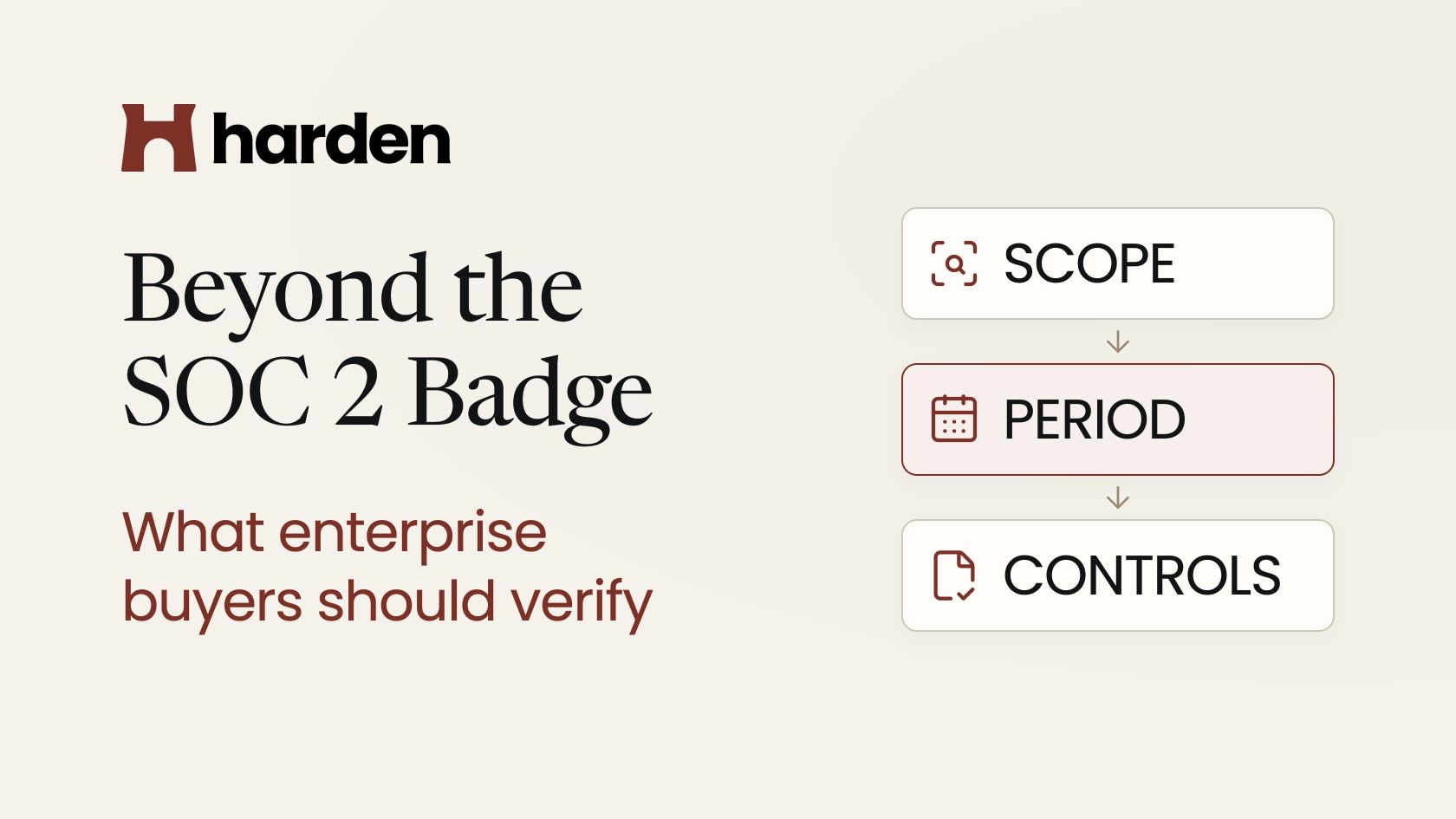
A SOC 2 badge is a starting point for vendor review, not evidence that an AI security product stops a particular agent action. Buyers should examine the actual report, the system and services it covers, the relevant period, the auditor's findings and the responsibilities left to the customer. Review that assurance evidence beside the product's data flow and a workflow-specific security evaluation.
Begin with the report, not the logo
The AICPA describes SOC services as assurance reports that help users assess risks associated with outsourced services. That purpose is useful in procurement. It is different from a product demonstration showing whether an unsafe tool call is prevented.
Ask the vendor how an authorized reviewer can obtain the report. Confirm the legal entity, product and service boundaries described in it. A company name matching the sales presentation is not enough if the service your team plans to use is outside the reviewed system.
Use your assurance, legal and security teams to interpret the report and contract. The questions below are a procurement worksheet, not a substitute for that review.
Match the reviewed system to the proposed deployment
Draw the expected data path before reading assurances in isolation. For an AI security deployment, relevant components may include an endpoint application, a management console, hosted analysis, storage and external service providers.
Identify which components receive source code, prompts, tool arguments, credentials or decision records. Then ask which of those components fall within the report's description and which are covered through another arrangement.
Do not infer the answer from a single label such as “local,” “private” or “enterprise.” A product may evaluate one operation locally while using a hosted service for administration or selected records. The exact configuration and data flow matter.
Check dates, findings and customer responsibilities
Confirm the report type and the dates it addresses. For a Type II report, ask your reviewer to assess the period covered and the operating-effectiveness evidence relevant to the service you will use. If the report predates a material product change, ask how the change affects the assurance you can rely on.
Read exceptions and management responses with a qualified reviewer. Ask what the findings mean for your deployment, which remediation is complete and what evidence supports that conclusion.
Also identify responsibilities assigned to your organization. Access management, configuration and other customer-side controls cannot be treated as completed merely because the vendor has a report. Give each relevant responsibility an internal owner.
Map assurance to the data you plan to expose
Buyer question | Evidence to request |
|---|---|
Which exact service is in scope? | Report system description and proposed order/service details |
What information leaves the endpoint? | Current data-flow documentation and configuration options |
Who can inspect recorded activity? | Access model, administrator roles and relevant controls |
How long is information retained? | Applicable settings, documented behavior and contract terms |
Which external services participate? | Current provider/subprocessor information and scoped responsibilities |
What must our team configure? | Customer responsibilities and deployment instructions |
Treat the table as a set of requests. Do not assume every vendor has the same architecture or that an unanswered public question proves a weakness.
Test runtime effectiveness separately
If you are buying action protection, evaluate a consequential operation in a controlled environment. For example, compare an approved internal diagnostic attachment with an attempted transfer to an unapproved destination, using synthetic information.
Inspect the observed effect, not only the alert. Ask whether the tool ran, whether any data was transmitted and which record explains the result. Repeat the legitimate operation to see whether useful work remains possible.
The SOC 2 report and that test answer different questions. One contributes assurance about the described service and controls. The other contributes evidence about a particular workflow, product configuration and execution path. Neither should be stretched beyond its scope.
Keep vendor claims proportionate
Avoid turning “SOC 2 audited” into a promise of complete security, universal compliance or protection against every agent threat. Ask for the report and the evidence relevant to the claim being made.
The same discipline applies to us and to any other supplier. A public audit statement does not establish which endpoint behavior was tested in the report or whether a particular deployment is covered. Those questions require the report, deployment details and an authorized review.
Make the purchasing decision traceable
Work through an unanswered scope question
Suppose a proposed deployment includes a developer endpoint and a hosted management console. Your team expects some decision records to reach the console, but the report supplied during procurement describes a service name that is difficult to match to that architecture. Do not assume inclusion or exclusion. Ask the vendor to explain the mapping and have your assurance reviewer evaluate the response against the report.
Record the exact uncertainty: which component, which information and which responsibility remain unclear? An answer about general company security may not resolve a question about the specific service handling your records. Keep the deployment diagram and proposed configuration beside the report so reviewers are discussing the same system.
Then assign the next decision. Procurement may need a document, security may need a data-flow clarification and engineering may need a test of a configurable behavior. Keep those requests separate so an answer to one does not accidentally close all three.
This is a hypothetical due-diligence example, not a finding about our controls or another supplier. Apply the same evidence standard to every shortlisted vendor. If our supported action checks are part of the technical evaluation, use our published research to frame that test while obtaining assurance evidence through the appropriate review process.
Keep a short decision record linking the report, the proposed service, the data-flow review, technical test results and unresolved responsibilities. Assign an owner and review date to each outstanding item.
The procurement meeting should end with a clear account of what the assurance establishes, what your technical evaluation establishes and what your organization still needs to do. That is a stronger basis for adoption than a badge copied into a comparison spreadsheet.
FAQs
Does a SOC 2 report prove an AI security product is effective?
It contributes assurance within the described system, criteria and report scope. It should not be treated as a test of every agent-security claim. Evaluate the relevant tool path and configuration separately, then have qualified reviewers explain how the report's findings apply to the service your organization intends to use.
What if the vendor's report is not publicly downloadable?
Ask how an authorized reviewer can obtain it and what access conditions apply. The absence of a public download does not establish that no report exists. Procurement should track whether the requested evidence was received, reviewed and applicable, rather than treating website availability as the assurance decision.
How should buyers handle a report that predates a product change?
Identify the change, its date and the affected service or control. Ask what evidence addresses the intervening period and have the assurance reviewer assess its relevance. Do not invent a universal acceptable age or assume that an unchanged company name means the proposed service remained unchanged.
Can runtime tests replace the assurance review?
No. A controlled test can show what happened for a particular operation. It does not establish all the organizational and service controls examined during procurement. Preserve both evidence streams and their limits. A blocked synthetic transfer and a reviewed report answer related, but different, questions about adoption.
How should a team begin evaluating Harden during procurement?
Start by describing the workflow, sensitive information and proposed deployment. A Harden evaluation can help organize the supported action-control portion. Request the current assurance material through the appropriate vendor-review process. Creating an account is not an assurance review, deployment approval or proof that protection is configured.