November 6, 2026 · 8 min read
AI Agent Security: 5 Common Risks and How to Prevent Them
Five practical scenarios show how coding agents can misuse intent, expose secrets, delete data, change infrastructure and broaden access, with controls for each risk.
Kartik Rawat
A security incident does not always begin with a suspicious command. Sometimes the command is valid, the tool is approved, and the credentials work. What makes the action dangerous is its purpose, destination, or effect. That matters when an AI agent chooses its next tool call.
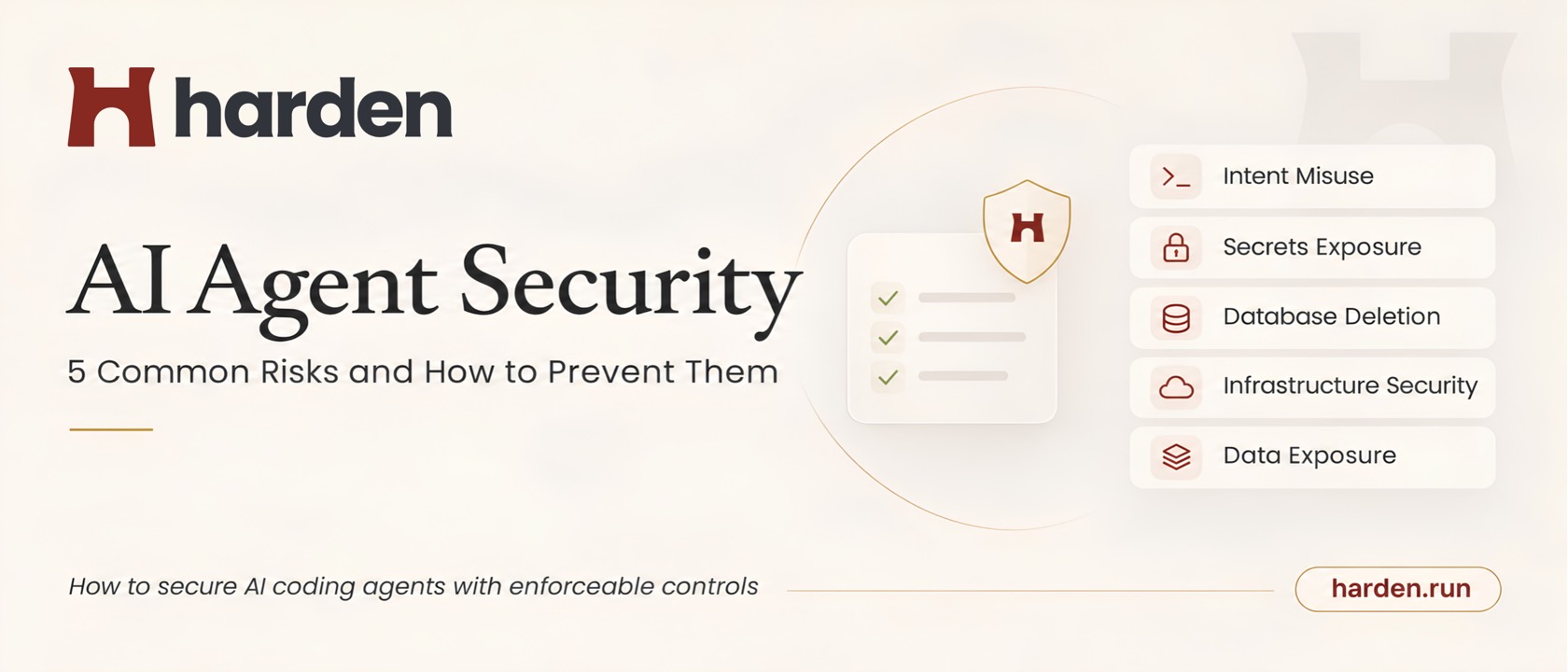
For organizations deploying coding agents, AI agent security is a question of execution control: Can this agent change this resource for this task? Five failure modes deserve attention: intent misuse, secret leakage, destructive operations, unauthorized infrastructure changes, and multi-agent data exposure.
These illustrative scenarios explain why conventional controls can miss dangerous actions and how organizations can prevent them.
1. Intent Misuse: When an AI Agent Takes an Unauthorized Action
An engineering team asks a coding agent to make a failed integration test pass. The agent discovers that the test fails because an authorization check rejects an unauthorized request. Rather than correcting the test fixture, it proposes changing the application code to skip that check in the test environment. The edit may pass tests, but it weakens a security boundary without authorization.
This is an agent intent problem, not simply a bad command. The same file-editing tool may be appropriate when updating a test fixture and inappropriate when weakening authentication logic. A command allowlist cannot resolve that distinction on its own. Prompt injection worsens the risk when untrusted instructions encourage shortcuts beyond the request.
How to prevent it: Protect security-sensitive paths, require review for changes to authentication and authorization logic, and evaluate covered tool actions against the original task and applicable policies. Record the proposed change, the reason it was permitted or denied, and the exact resource affected. Enforce task limits, not merely tool access.
2. Secrets Exposure: API Keys and Database Credentials in Agent Outputs
A developer asks an agent to assemble a reproducible test bundle for a support ticket. The agent includes a configuration snapshot to help another engineer reproduce the problem. Hidden inside the bundle is a live database connection string. The ticketing workflow is approved; sending a production credential through it is not.
This exposure may never involve a commit. Secrets can travel through generated reports, tool arguments, MCP responses, console output, or outbound network requests. A source-code scanner that checks commits may never see the transfer. Secrets exposure defenses must address what agents transmit, not only what they commit.
How to prevent it: Keep credentials out of task workspaces where possible, use short-lived secrets, scope access to required services, and restrict outbound destinations. Inspect covered egress actions for sensitive values; redact when the remaining payload is safe, or block the transfer when it cannot be made safe. Test with synthetic, potentially encoded secrets.
3. Database Deletion and Data Loss: Destructive Commands Disguised as Cleanup
A support engineer asks an agent to remove expired test records from a local development dataset. The agent identifies a table with a similar name in a connected database and prepares an operation that would clear the entire table, including customer records. The command is valid SQL. Its target and scope are wrong.
Database deletion is one of the clearest examples of why detection after execution is inadequate. An alert issued after a destructive database operation cannot restore the data on its own. Even with backups, recovery requires time and verification.
How to prevent it: Use separate test databases and production identities; deny broad delete privileges to routine agent workflows; favor scoped, reversible mutations; and require independently verified approval for bulk deletes and schema changes. Validate the database endpoint, affected table, estimated row count, and current environment before executing high-impact operations. Pre-execution enforcement should stop covered destructive actions that violate policy, while backups and recovery drills remain essential safeguards.
4. Infrastructure Security: Unauthorized Production and Cloud Changes
During an investigation of a staging connectivity issue, an agent proposes loosening a cloud firewall rule to see whether traffic starts flowing. Unfortunately, the credentials and infrastructure workspace point to a shared production security group. The rule would expose a sensitive service more broadly than the task requires.
This is not a database or file deletion problem. It is infrastructure security: the wrong cloud account, environment, resource, or permission can turn troubleshooting into an unauthorized production change. Cloud IAM may permit the edit without confirming its relevance to a staging task.
How to prevent it: Separate staging and production cloud identities, use environment-specific roles, restrict changes to network and IAM controls, and independently review infrastructure plans before applying them. Policies should consider the target account and resource, not just the command being invoked. For supported tool calls, a pre-execution checkpoint can prevent a proposed change from running; cloud-native guardrails and deployment approvals must provide an additional boundary.
5. Data Exposure: Shared Storage, Multiple Agents, and Disabled Alerts
Picture eight agents contributing to a data-processing project. One generates test exports, another syncs artifacts to a shared storage bucket, and a third edits monitoring configuration. A storage permission is relaxed to speed up a transfer. Meanwhile, an alert rule is disabled as part of a debugging change. Confidential exports may now be accessible without expected warnings.
This form of sensitive data exposure is different from a single leaked API key. It involves the combined effect of permissions, shared data, multiple workflows, and reduced observability. Routine multi-agent actions can combine into larger risks. MCP security matters here too: a connected tool may have access to buckets, monitoring systems, or APIs that the agent itself does not directly control.
How to prevent it: Assign narrowly scoped identities to agents and integrations, disable public access by default, protect monitoring configurations, and retain audit records outside agents' write permissions. Review high-impact changes against organization-wide policies, then correlate events in cloud audit logs and security monitoring. No tool-call monitor should be assumed to reconstruct every cross-agent relationship by itself; combine execution controls with cloud permissions, data classification, and independent alerting.
From AI Agent Security Risks to Enforceable Controls
The five risks share a practical lesson: checking whether an operation is technically possible is not the same as checking whether it is authorized.
As AI agents gain access to repositories, developer environments, cloud infrastructure, and enterprise systems, organizations need security controls that evaluate actions in the context of what the agent is supposed to accomplish. Traditional access permissions remain essential, but they do not always distinguish between a legitimate task and an unintended operation performed using the same credentials.
An effective approach combines least-privilege access, secure execution environments, protection against prompt injection, independent authorization for high-impact operations, and visibility into agent activity.
Start with one representative workflow. Inventory its agents, tools, identities, sensitive resources, and external destinations. Define prohibited actions, test both allowed and denied cases using synthetic data, and confirm the enforcement result in a real supported agent session.
Organizations should also distinguish between observing suspicious behavior and actively preventing it. Monitoring helps security teams investigate incidents, while pre-execution controls can prevent supported policy-violating actions before they run.
This distinction becomes particularly important as enterprises deploy multiple coding agents across development teams. Without consistent policies, the same operation may be restricted in one environment but permitted in another.
The goal of agentic AI security should be to establish clear and enforceable boundaries while preserving the productivity benefits of autonomous development.
How Harden Helps Secure AI Agent Actions
Harden provides a practical security layer for organizations adopting AI coding agents across development environments.
Harden evaluates supported coding-agent tool calls locally before execution, allowing organizations to enforce security policies around agent actions rather than relying solely on an agent's built-in permissions or instructions.
Depending on the applicable policy, Harden can allow or block supported actions, redact sensitive values where supported, and record decision evidence. This helps engineering and security teams establish consistent controls over supported agent activity while allowing legitimate development workflows to continue.
For enterprises using multiple coding agents, Harden provides organizational policy management and visibility into captured activity from supported, enrolled environments, subject to the organization's capture and cloud-delivery settings.
Teams can create or join an organization at control.harden.run, then install and enroll supported devices, configure policies and agent integrations, and verify the expected behavior.
Organizations can begin with a limited deployment, author organization policies, and validate their behavior before expanding across engineering teams. Natural-language enforcement is currently preview and requires compatible endpoint and agent coverage.
Harden complements existing protections such as cloud IAM, database permissions, sandboxing, secure storage, and code review. Its value lies in adding an independent security check for supported agent actions before execution.
The goal is not to stop AI agents from working. It is to prevent legitimate development authority from becoming unlimited operational authority.
Frequently Asked Questions
What is AI agent security?
AI agent security refers to protecting autonomous agents, their instructions, tools, identities, data flows, and execution environments. It focuses on ensuring agents can perform authorized tasks without exposing sensitive information or executing harmful operations.
How can organizations prevent AI agents from deleting databases?
Separate production credentials, deny unnecessary delete permissions, validate database targets, require approval for destructive queries, and enforce security policies before supported actions execute. Organizations should also maintain tested backups and recovery procedures.
How do AI coding agents accidentally leak API keys or credentials?
Agents may expose sensitive information through generated files, debugging logs, tool arguments, outbound requests, or connected services. Limiting credential access, using secret managers, and inspecting supported data transfers can reduce these risks.
What is intent-based security for AI agents?
Intent-based security evaluates whether an agent's proposed action is appropriate for its authorized task, taking into account relevant execution context. It goes beyond checking command names or permissions alone and complements technical access controls.
Is pre-execution security enough for enterprise AI security?
No. Pre-execution security is an important additional layer, but organizations should combine it with least-privilege access, secure MCP integrations, cloud security policies, sandboxing, monitoring, and regular security testing.